Quick Build & Economics Summary
| Component / Spec | Exact Model / Selection | Key Metric / Economics |
|---|---|---|
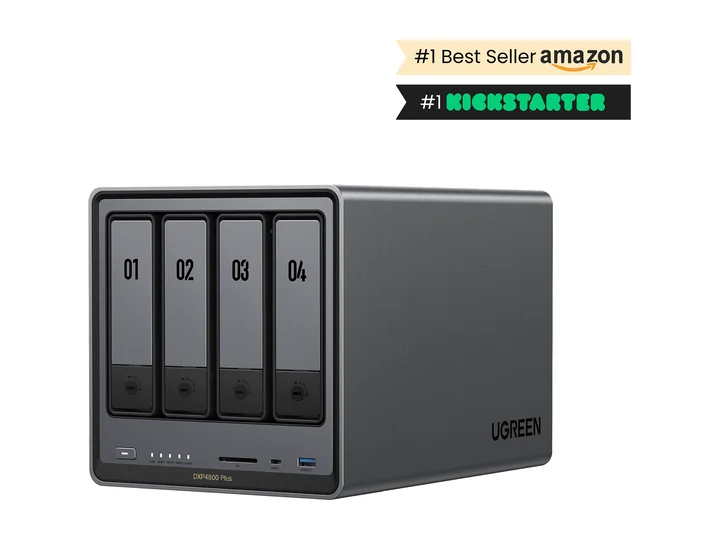
| Recommended NAS | NASync DXP4800 Plus (4 Bays · 1 × 10GbE + 1 × 2.5GbE) | Intel Pentium Gold 8505 · 5-core · 8GB RAM |
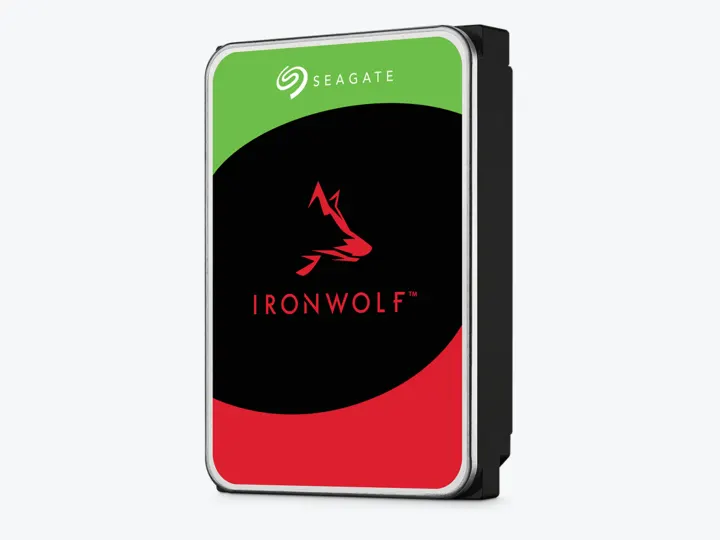
| Selected Hard Drives | 4 × 4TB (ST4000VN006) | CMR CMR · 5,400 rpm |
| Planning Capacity | 12TB usable | The array can continue after one drive fails; container volumes and irreplaceable data still need versioned backup. |
| Price estimate — recheck required | NASync DXP4800 Plus + 4 × ST4000VN006: $1,379.95 estimated total | $115.00 / usable TB |
Who this build is for
- Multiple containers, dashboards, automation, and moderate media use
- A 2.5/10GbE home network or fast backup workflow
- Users who can manage application backups and accept a younger OS
Why this NAS and tier win
DXP4800 Plus offers the strongest midrange hardware balance in the current catalog: Intel 8505, expandable DDR5, four bays, dual M.2, 10GbE and 2.5GbE. Major-media reviews consistently identify hardware as the win and software maturity as the loss. [1][2][3]
A developer-oriented exact-model video asks whether the NAS can replace a home server, which is the right framing. The answer is workload-dependent: an appliance can consolidate light services, but experimentation and storage failure domains still need separation. [4][5]
Why these exact drives
Four exact 4TB CMR drives yield about 12TB under single parity. This intentionally avoids the research draft’s unsupported jump to very large disks when the scenario evidence focused on compute, RAM, and networking. [6]
Active VM/container workloads should use an appropriate protected SSD layout if supported; HDDs remain useful for bulk data, backups, and media. [1]
Capacity and protection plan
4 equal 4TB drives with 1 drive-equivalent reserved for redundancy produce an editorial planning estimate of 12TB decimal usable before formatting, filesystem metadata, snapshots, applications, and free-space reserve.
The array can continue after one drive fails; container volumes and irreplaceable data still need versioned backup. Reconfirm the RAID/SHR/RAIDZ behavior for the exact operating system and chosen disk layout before initialization.
What YouTube and community evidence change
Homelab users value standard x86 hardware and alternative-OS options, but frequently recommend separating compute from storage when uptime, upgrades, or security matter. This build is an all-in-one convenience choice, not the only architecture. [5]
The large NASCompares review audience adds useful UI and hardware coverage, but affiliate links are disclosed and the video is not counted as independent from its companion editorial work. [7]
Trade-offs before buying
Recommended setup sequence
- 1Reserve memory for storage services before assigning it to containers.
- 2Use reproducible compose files and versioned configuration.
- 3Create separate datasets/shares for application state and user data.
- 4Back up container volumes before every major UGOS or app update.
- 5Use VPN, MFA, patching, and disabled UPnP rather than direct WAN exposure.
Alternatives worth considering
Frequently asked questions
Why use four 4TB drives instead of two 8TB drives in a homelab NAS?
Four drives in RAID 5 provide higher parallel read throughput (~3× single drive read speed), distribute IOPS across more spindles, and provide ~12TB usable storage while keeping drive replacement costs lower.
Can the DXP4800 Plus expand to 64GB of RAM?
UGREEN lists support for up to 64GB DDR5 on the DXP4800 Plus. Confirm the required module and slot configuration in the current model documentation before ordering; the DXP2800 has a different supported limit.
How does 10GbE benefit a Docker/Homelab environment?
10GbE raises the network ceiling to 1.25GB/s before overhead, which can help large transfers or shared storage for another computer. It does not match local NVMe latency or guarantee that an HDD array reaches that speed. Check the client adapter, switch, pool throughput, and workload together.
Can I run a full Kubernetes / k3s cluster on this NAS?
Yes, with expandable RAM and multi-core x86 architecture, the DXP4800 Plus can easily host multi-node k3s container orchestration environments.
Sources and evidence boundary
This article synthesizes official product facts, independent reviews, YouTube material, and community discussion. YouTube view/like/comment counts are a dated engagement signal, not a quality score. Community posts are anecdotal and cannot establish failure rates. Reviewers may use affiliate links; one publisher’s article and companion video count as one editorial viewpoint.
UGREEN · accessed Aug 31, 2026. Intel 8505, 8GB DDR5, four bays, dual M.2 and 10GbE plus 2.5GbE.
Android Central · May 13, 2024 · accessed Aug 31, 2026. Highlights unusually strong hardware, Intel media capability and 10GbE while treating software maturity as the trade-off.
ITPro · accessed Aug 31, 2026. Finds the micro-business hardware fast and highly specified but identifies software gaps.
DevWithZachary · Sep 15, 2025 · accessed Aug 31, 2026. Developer-oriented home-server assessment of the exact DXP4800 Plus.
Engagement at capture: 1,739 views; 57 likes; 19 comments at capture.
Reddit r/homelab · accessed Aug 31, 2026. Community example of the UGREEN four-bay platform in a broader homelab, useful as experience rather than a reliability rate.
Seagate · accessed Aug 31, 2026. NAS-oriented CMR family; exact 4TB and 12TB MPN facts are stored in the ChooseCompute catalog.
NASCompares · Mar 22, 2024 · accessed Aug 31, 2026. Long-form hardware, UGOS, 10GbE and workload walkthrough with disclosed affiliate links.
Engagement at capture: 102,497 views; 1,606 likes; 323 comments at capture.