Quick Build & Economics Summary
| Component / Spec | Exact Model / Selection | Key Metric / Economics |
|---|---|---|
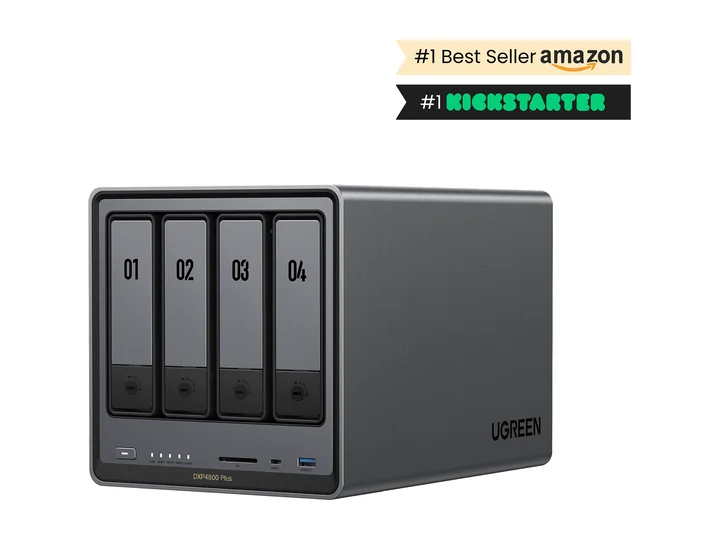
| Recommended NAS | NASync DXP4800 Plus (4 Bays · 1 × 10GbE + 1 × 2.5GbE) | Intel Pentium Gold 8505 · 5-core · 8GB RAM |
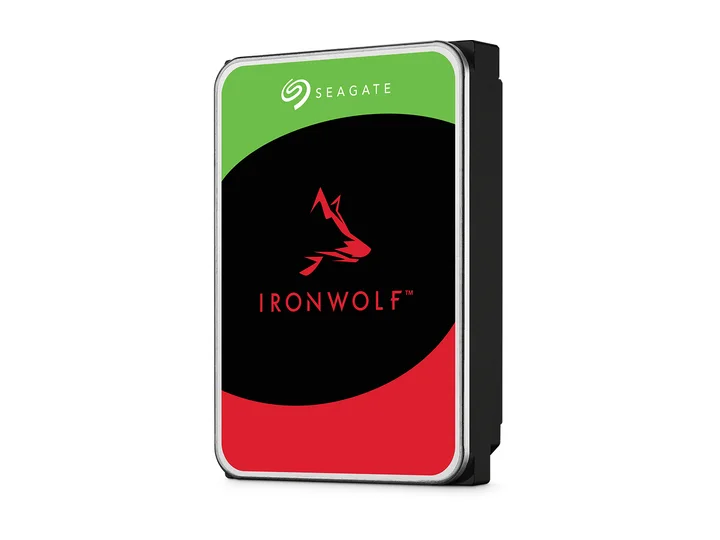
| Selected Hard Drives | 4 × 12TB (ST12000VN0008) | CMR CMR · 7,200 rpm |
| Planning Capacity | 36TB usable | The array can continue after one drive fails; RAID is not a backup. |
| Price estimate — recheck required | NASync DXP4800 Plus + 4 × ST12000VN0008: $2,079.95 estimated total | $57.78 / usable TB |
Who this build is for
- Large movie/TV libraries with multiple Direct Play clients
- Owners who also run a few containers
- Networks that can use 2.5GbE now or 10GbE for bulk transfers
Why this NAS and tier win
The DXP4800 Plus combines an Intel 8505, 8GB DDR5, four bays, dual M.2, 10GbE and 2.5GbE at a price where rivals often provide weaker hardware. Android Central and ITPro both recognize the performance/value advantage while identifying software as the gap. [1][2][3]
A 100,000-view specialist video examines hardware, UGOS, networking, and workloads, but its article/video/affiliate ecosystem counts as one editorial cluster, not multiple independent votes. The recommendation therefore also relies on major-media and community evidence. [4][5]
Why these exact drives
Four 12TB IronWolf drives provide three drive-equivalents under single parity, or about 36TB decimal usable. This is a capacity-focused media layout; users prioritizing rebuild tolerance can choose dual parity and accept about 24TB. [6]
Four 7200rpm disks are audible. Network and processor specifications cannot compensate for placing the array in a quiet viewing room. [7]
Capacity and protection plan
4 equal 12TB drives with 1 drive-equivalent reserved for redundancy produce an editorial planning estimate of 36TB decimal usable before formatting, filesystem metadata, snapshots, applications, and free-space reserve.
The array can continue after one drive fails; RAID is not a backup. Reconfirm the RAID/SHR/RAIDZ behavior for the exact operating system and chosen disk layout before initialization.
What YouTube and community evidence change
UGREEN owner and homelab discussions confirm active Plex, Docker, and alternate-OS interest, while also surfacing update and support concerns. That is stronger evidence for capability than for long-term appliance reliability. [5][8]
Plex community experience repeatedly shows subtitles and tone mapping can become the bottleneck even when the Intel GPU is capable. Direct Play remains the default recommendation. [9][10]
Trade-offs before buying
Recommended setup sequence
- 1Choose RAID5 only after deciding whether 36TB capacity outweighs dual-parity risk.
- 2Place the NAS away from seating and preserve cooling airflow.
- 3Test Direct Play, remote bandwidth, PGS subtitles, HDR tone mapping, and audio conversion.
- 4Use M.2 storage only for a supported purpose such as applications or a protected pool.
- 5Back up Plex metadata and personal media to a separate destination.
Alternatives worth considering
Frequently asked questions
Should I choose RAID 5 or RAID 6 for four 12TB drives?
RAID 5 provides ~36TB usable storage and tolerates 1 drive failure. RAID 6 provides ~24TB usable storage and tolerates 2 drive failures. For media streaming where files can be re-ripped or restored from backup, RAID 5 is popular for maximizing storage per dollar.
Does 10GbE networking improve 4K Plex streaming?
Individual 4K UHD Remux streams consume 50 to 120 Mbps, which easily fits within 1GbE. 10GbE is primarily beneficial for transferring multi-terabyte movie libraries from your workstation to the NAS in minutes.
Why is the Intel Pentium Gold 8505 strong for Plex?
The Intel 8505 features 1 Performance core, 4 Efficient cores, and an integrated Intel UHD Graphics GPU with 48 Execution Units (EUs), providing substantial Quick Sync video encoding and decoding headroom.
Can I install TrueNAS or unRAID on the DXP4800 Plus?
Yes, the hardware uses standard x86 UEFI architecture and supports booting third-party operating systems from USB/NVMe, though initial BIOS setup and driver verification are the owner’s responsibility.
Sources and evidence boundary
This article synthesizes official product facts, independent reviews, YouTube material, and community discussion. YouTube view/like/comment counts are a dated engagement signal, not a quality score. Community posts are anecdotal and cannot establish failure rates. Reviewers may use affiliate links; one publisher’s article and companion video count as one editorial viewpoint.
UGREEN · accessed Aug 31, 2026. Intel 8505, 8GB DDR5, four bays, dual M.2 and 10GbE plus 2.5GbE.
Android Central · May 13, 2024 · accessed Aug 31, 2026. Highlights unusually strong hardware, Intel media capability and 10GbE while treating software maturity as the trade-off.
ITPro · accessed Aug 31, 2026. Finds the micro-business hardware fast and highly specified but identifies software gaps.
NASCompares · Mar 22, 2024 · accessed Aug 31, 2026. Long-form hardware, UGOS, 10GbE and workload walkthrough with disclosed affiliate links.
Engagement at capture: 102,497 views; 1,606 likes; 323 comments at capture.
Reddit r/homelab · accessed Aug 31, 2026. Community example of the UGREEN four-bay platform in a broader homelab, useful as experience rather than a reliability rate.
Seagate · accessed Aug 31, 2026. NAS-oriented CMR family; exact 4TB and 12TB MPN facts are stored in the ChooseCompute catalog.
SomeTechGuy · Jun 14, 2025 · accessed Aug 31, 2026. Measured 4TB performance, noise and power comparison across the four NAS HDD families; affiliate links are disclosed.
Engagement at capture: 54,339 views; 1,522 likes; 166 comments at capture.
DevWithZachary · Sep 15, 2025 · accessed Aug 31, 2026. Developer-oriented home-server assessment of the exact DXP4800 Plus.
Engagement at capture: 1,739 views; 57 likes; 19 comments at capture.
Reddit r/PleX · accessed Aug 31, 2026. Discussion illustrates that subtitle burn-in can become the limiting Plex path even when Quick Sync exists.
Plex Support · accessed Aug 31, 2026. HDR-to-SDR conversion support varies by server platform and hardware path.